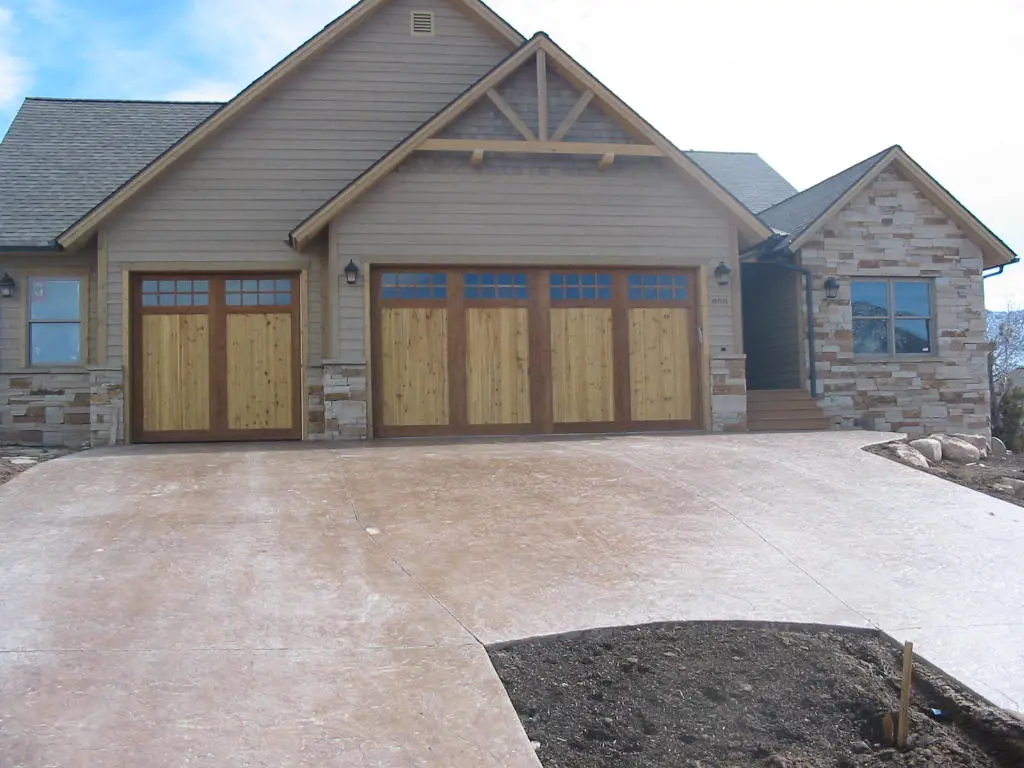
Wood and glass garage doors on a new construction home

Maintenance · Grand Junction

Garage door maintenance in Grand Junction

Doors give notice before they fail. This is the visit that reads it. Almost nothing on a garage door fails silently. It gets noisy, it slows down, it runs crooked, the seal starts letting light through, the opener works a little harder each month. Those are the months when a scheduled visit is cheap — and after which the same problem becomes an urgent call, at an urgent price, on the morning you least wanted it.

Since 2006·Free estimates·Grand Junction shop

You getYou get fewer surprises, a written note of what is wearing, and enough warning to plan a replacement instead of reacting to one.
Free estimatesOn planned work, so you see the whole number before you agree to anything.
Call or textCall if it is urgent. Text photos if it is not — either reaches the shop.

Working it out

What you are actually deciding.

Your door has started making a noise you have begun to ignore — or you run a bay that genuinely cannot be down and you would rather choose when it is serviced.

Does your door actually need a scheduled visit?

A low-use residential door in good order genuinely does not need one every year. Lubricating the rollers and hinges yourself and watching the balance will carry you a long way, and we would rather say that than sell you a plan. What changes the answer is cycle volume, a door you cannot afford to have down, or a door that has started telling you something.
How do you know when a door is warning you?

Noise that has changed, rather than noise that is simply there. A door that runs crooked or hesitates on the way up. Daylight along the bottom seal. An opener that works audibly harder in cold weather. A gap opening between a section and its hinge. Any one of those is worth a look. Two together is worth booking.

Calendar interval, or cycle count?

For a house, calendar is fine. For a commercial bay it is misleading, because a door doing eighty cycles a day ages ten times faster than one doing eight and the calendar cannot tell the difference. Set commercial intervals against counted cycles and you stop over-servicing the quiet bays and under-servicing the ones that matter.

When does maintaining it stop being worth it?

When wear items are being replaced faster than they wear out, when parts have gone obsolete, or when the door itself is out of square. At that point the visit's real job is to hand you a replacement plan with a date on it rather than a surprise — and we will say so plainly rather than keep servicing something that is finished.

What the work covers

What we do for you here.

Maintenance pricing follows the number of doors, their size, the operator types, travel and access, and whether parts get replaced on the day. You are told before anything beyond the inspection is done.

  • Balance and travel check on the door as it stands
  • Rollers, hinges, tracks, cables, springs, and fastener inspection
  • Weather seal and threshold review
  • Opener, remotes, keypads, safety devices, and control checks
  • Commercial maintenance intervals planned around real cycle volume

Before you spend anything

You may not need all of this.

Maintenance does not rescue a door that is already unsafe or badly damaged. If yours is at that point we will tell you it needs repair or replacement rather than sell you a service visit that cannot help it.

  • Book it before your busy season, a tenant turnover, or the run-up to winter — not during.
  • Ask which parts are wear items and which symptoms mean the door is aging out rather than needing a tweak.
  • For a commercial bay, bring an approximate daily cycle count and any recent downtime.
  • Ask for what was found in writing. It is the document that justifies the replacement budget later.

What happens

How the job runs, step by step.

So you know what to expect and where you get to say no.

  1. 01

    Listen to it run

    Noise, vibration, slow response, crooked travel, and gaps at the seal usually point straight at whatever is going to fail next.

  2. 02

    Inspect the wear points

    Springs, cables, rollers, hinges, tracks, fasteners, operator behaviour, and safety devices — the parts that carry load and the parts that stop the door hurting someone.

  3. 03

    Correct what is practical on the day

    Tighten, adjust, lubricate, and replace minor wear items, and flag anything that should be quoted properly rather than bodged on the visit.

  4. 04

    Set the next interval and tell you what to watch

    A residential door gets a sensible period; a commercial door gets an interval matched to counted cycles, plus the symptoms that mean call sooner.

What moves the price

Where your money actually goes.

  • How many doors, what size, and residential or commercial use
  • Operator types, and how many controls, keypads, remotes, and safety devices need checking
  • Travel distance, site access, and any after-hours requirement
  • Whether wear parts get replaced during the visit or quoted separately
  • Whether the visit turns into a repair or a replacement conversation

Worth knowing

The things that decide whether it lasts.

  • Cycle count ages a door far more accurately than the calendar does, which is why commercial intervals should be set against counted cycles rather than a date.
  • Rollers, hinges, and bearing plates are the cheap parts whose failure damages expensive ones — a seized roller works quietly on the track and the section behind it.
  • Western Colorado dust is abrasive and finds every bearing surface, which is why lubrication intervals here are not the ones printed in a manual written for a milder climate.
  • A maintenance record is what lets a facility manager argue for planned replacement inside a budget cycle, before an unplanned failure argues it for them.

Why us

Four things you can check before you call.

Everyone says they are honest and local. These are the parts of that you can verify without taking our word for any of it — and the same questions work on whoever else you are calling.

  • We will tell you when you do not need us.

    It is written on this page, above: a sound low-use residential door does not need an annual visit, and lubricating it yourself will carry you a long way. A maintenance plan sold to every door regardless of use is a subscription, not a service.

  • Commercial intervals get set by counted cycles, not by the calendar.

    It is step four of our published process here, and the reasoning is on this page. A calendar interval over-services your quiet bays and under-services the ones that would actually hurt to lose.

  • You get what was found in writing.

    Not as a courtesy — because it is the document that lets you plan a replacement inside a budget cycle rather than fund one out of an emergency. Ask any contractor for it; the ones working to a standard already produce it.

  • We work to the published standards rather than to house rules.

    DASMA sets the sectional door and operator standards and the CPSC publishes the entrapment-protection requirements. Both are linked from our comparison page, so you can read what a competent inspection is meant to cover and then hold us to it.

Where you are

Maintenance in your town.

Open the page for your town and you get what goes wrong there, how we reach you, and what to send so the price comes back right the first time.

Wood and glass garage doors on a new construction home

Before you call

Questions we get asked most.

How often should a commercial overhead door be serviced?

Set it by cycles rather than by the calendar. A high-cycle service bay wears out an order of magnitude faster than a low-use storage door with an identical opening, and a date-based interval cannot tell them apart.

What are the signs my door needs attention?

Noise that has changed, uneven or hesitant movement, a door running crooked, daylight along the bottom seal, loose hardware, an opener working audibly harder, or sensors that need nudging to behave. One is worth a look. Two together is worth booking.

Can I maintain the door myself?

A good deal of it, yes. Lubricate the rollers, hinges, and springs, keep the tracks clear, test the safety reversal with a block of wood, and watch the balance by lifting it by hand. What we would rather you left alone is anything under tension — springs, cables, and the bottom brackets.

Will maintenance prevent every failure?

No, and anyone promising that is overselling it. What it does is cut out the preventable failures and give you enough warning to replace a door on your schedule instead of on its own.

Nearby

Towns we cover for this.

  • Grand Junction — Whatever your door is doing, we have almost certainly seen it here: custom-home faces, commercial bays that cannot be down, dead openers, snapped springs, and the ordinary replacement that has been put off for two years.
  • Redlands — A Redlands door gets chosen the way the rest of your exterior was — against the stone, the roofline, and the angle the driveway is seen from.
  • Clifton — Clifton calls are usually urgent and usually practical: spring repair, an opener replacement, panel damage, and doors that need to close and stay closed.
  • Fruitvale — Fruitvale jobs are the practical ones — a useful repair, a better opener, decent seals, and a replacement door that suits the house rather than shows off.
  • Pear Park — Around Pear Park it is repair, openers, seals, panels, and sensible replacement — with the repair option quoted alongside the replacement, not instead of it.
  • Orchard Mesa — Orchard Mesa jobs tend to mix residential repair with detached garages, shop doors, opener access, and the maintenance that has been put off.
  • Fruita — Most Fruita calls come down to a replacement door, an RV or shop bay, an opener that has given up, or a repair on a door that gets opened far more often than a two-car garage does.
  • Palisade — Around Palisade one visit can cover a house door, a working bay, and an outbuilding — so it pays to say up front which of them you actually care about.

Free Estimate

What can we help with?

You get fewer surprises, a written note of what is wearing, and enough warning to plan a replacement instead of reacting to one.

1 · You2 · The door3 · Detail4 · Where5 · Send
What do you need?
What type of property?

Broken door and need someone today? Calling is faster than typing.

CallTextEstimate