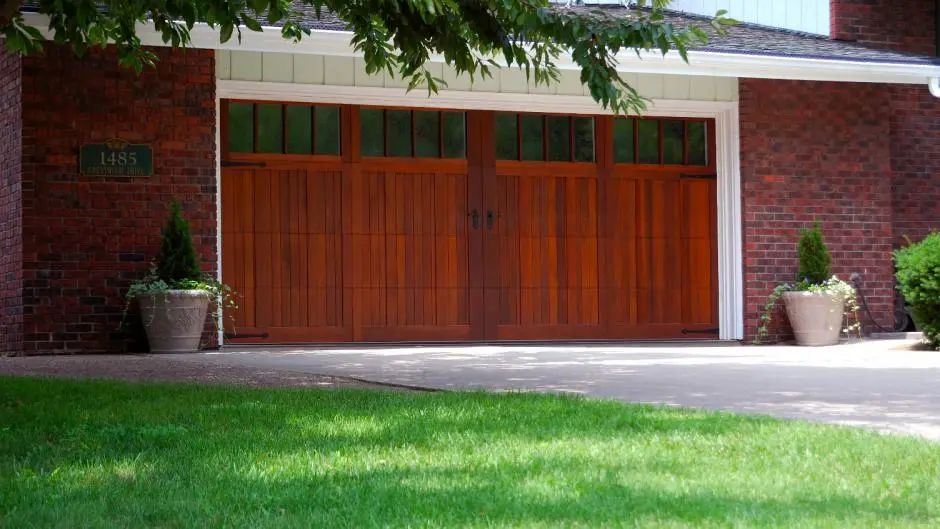
Mahogany-style residential garage door with windows

Openers · Grand Junction

Garage door openers in Grand Junction

Before you buy a stronger motor, find out whether the motor is the problem. An opener that strains, hums, or gives up halfway is usually reporting on the door rather than on itself. A door is meant to be counterweighted by its springs so the motor only has to nudge it. When the springs weaken, all that weight lands on a machine designed to move about ten pounds of it — and replacing the machine buys you a new one losing the same fight.

Since 2006·Free estimates·Grand Junction shop

You getYou get an opener sized to a door that has been checked first, and controls set up around how the people in the building actually come and go.
Free estimatesOn planned work, so you see the whole number before you agree to anything.
Call or textCall if it is urgent. Text photos if it is not — either reaches the shop.

Working it out

What you are actually deciding.

Your opener hums without moving, reverses for no reason, works from the wall button but not the remote, has no photo-eye sensors, or is loud enough to wake the house.

Is it the opener or the door? Here is the sixty-second test.

Close the door fully, pull the release cord, and lift by hand. A healthy door rises with about ten pounds of effort and stays put when you leave it halfway. If it is heavy, drops, or shoots up, your springs are the problem and the opener is innocent. Do this before you let anyone sell you a motor. It costs nothing and it settles the question.
Chain, belt, or wall-mount?

Chain drives are the cheapest and the loudest, which is fine over a detached garage and miserable under a bedroom. Belt drives cost more and are dramatically quieter. Wall-mount jackshaft units clear the ceiling entirely, which matters for high-lift doors, storage racks, and cathedral garage ceilings — and they cost accordingly. The ceiling above your door usually makes this decision for you.

Does your opener have working photo-eye sensors?

Look for two small units mounted no more than six inches off the floor on each track. If they are absent, your opener predates 1993 and does not meet the federal entrapment-protection requirement that has applied to every residential opener sold since. That is not an upsell — it is the reason those units exist, and it is the one opener replacement we will push you on.

Who needs to get in, and what happens when the power dies?

For a house that is remotes and a keypad. For a shop or a commercial bay it is a real question: which staff, at what hours, who locks it down, and how the bay opens during an outage. Battery backup, manual release, and control placement belong in the quote, not in the discovery phase of your first power cut.

What the work covers

What we do for you here.

Opener pricing comes down to drive type, the weight and duty of your door, the controls you want, the wiring already in place, and whether the door itself needs work first. Estimates on planned work are free.

  • Residential opener replacement and diagnostics
  • LiftMaster commercial operators, planned around duty and controls
  • Wall stations, remotes, keypads, and in-car button programming
  • Photo-eye sensors, force and travel settings, and safety reversal testing
  • Access planning for shops, detached garages, and commercial bays

Before you spend anything

You may not need all of this.

A new opener will not fix a heavy, unbalanced, bent, or binding door. If that is what is happening, buying a motor is buying the wrong thing, and we will say so before you spend it.

  • Do the hand-lift test before you call anyone, and tell us the result. It changes the conversation completely.
  • Send a photo of the opener's label. The model number tells us whether parts are still available and whether repair is worth it.
  • Say what is above the garage. A bedroom over the door is the single best argument for a belt drive.
  • For a commercial bay, tell us roughly how many times a day it cycles and how many people need access. Duty cycle is what sizes the operator.

What happens

How the job runs, step by step.

So you know what to expect and where you get to say no.

  1. 01

    Test the door with the opener out of the picture

    A balanced door moves properly by hand. If yours does not, that gets fixed first — otherwise you are buying a motor to fight a problem we have already found.

  2. 02

    Pick the drive to suit the building

    Chain, belt, or wall-mount jackshaft, chosen around your ceiling, your headroom, what is above the garage, and how hard the door works.

  3. 03

    Set the access up properly

    Wall station, remotes, keypad, and in-car buttons all programmed and handed over working, so nobody is left with a device they never got round to pairing.

  4. 04

    Verify the safety systems

    Photo eyes aligned, reversal tested with an obstruction, force and travel limits set, emergency release checked and explained to you.

What moves the price

Where your money actually goes.

  • Drive type — chain, belt, or wall-mount jackshaft
  • Horsepower and duty rating against the actual weight of your door
  • Battery backup, smart access, cameras, and how many remotes and keypads you want
  • Commercial operator duty, control stations, safety devices, and existing wiring
  • Whether the door needs spring, cable, roller, or track work before the opener goes in
  • Power availability at the ceiling, and access in a detached garage or shop

Worth knowing

The things that decide whether it lasts.

  • A correctly counterweighted door needs roughly ten pounds of force at the handle. Openers are built to supply that nudge, not to lift the door — which is why a weak spring kills a motor rather than the other way round.
  • Since 1993 every automatic residential opener sold in the US must have a secondary entrapment-protection system, which in practice means photo eyes. An opener without them is not merely old, it is below the standard.
  • Colorado licenses electrical contracting separately. A new dedicated circuit for an opener or a commercial operator is a different scope from hanging the door, and it belongs on the estimate as its own line.
  • Commercial operators are specified by duty cycle and control type, not by horsepower alone. A logic-controlled operator on a high-cycle bay behaves nothing like a residential unit doing the same number of opens.

Why us

Four things you can check before you call.

Everyone says they are honest and local. These are the parts of that you can verify without taking our word for any of it — and the same questions work on whoever else you are calling.

  • We check the door before we sell you a motor.

    It is step one of our published process for this service and the cheapest step in it. An opener fitted to an unbalanced door is a warranty claim with a date on it, and the failure comes back to us — so this is the practical answer as well as the honest one.

  • Photo eyes and the safety reversal get tested and the result told to you.

    The CPSC publishes the entrapment-protection requirement that has applied to every residential opener sold since 1993, and we link straight to it. If nobody mentions safety devices on their way out of your garage, they were not checked.

  • We install LiftMaster and we size the operator to the door.

    LiftMaster publishes its commercial operator range and duty ratings publicly — linked from our doors and openers page — so you can check a proposed model against your own door and cycle count rather than taking the recommendation on faith.

  • Electrical scope is named in the estimate rather than absorbed into it.

    Electrical contracting is licensed separately in Colorado and the state's licensing page is linked from our comparison page. If a new circuit is needed, you will see whose scope it sits in, in writing, before work starts.

Where you are

Openers in your town.

Open the page for your town and you get what goes wrong there, how we reach you, and what to send so the price comes back right the first time.

Mahogany-style residential garage door with windows

Before you call

Questions we get asked most.

Should I replace the opener or the door?

Do the hand-lift test first. Close the door, pull the release, and lift. If it is heavy or will not stay put halfway, the springs are the problem and a new opener will not fix it. If it rises easily and holds where you leave it, the opener is genuinely at fault and replacing it is the right call.

Why does my opener hum but not move?

Nearly always a broken spring. The motor is trying to lift a door that has suddenly become several times heavier than it was designed to move. Stop pressing the button — running a motor against a dead spring damages the opener as well as the door.

Is a belt drive worth the extra over a chain?

If there is a bedroom, an office, or a living space above or beside the garage, yes, and it is not close. If the garage is detached or the space above it is storage, a chain drive is perfectly good hardware and you can spend the difference elsewhere.

My opener has no sensors by the floor. Is that a problem?

Yes. Photo eyes have been required on every automatic residential opener sold in the US since 1993, and an opener without them cannot detect a child or a pet under a closing door. It is the one replacement we will push you on.

Can commercial bays use keypads and access control?

Yes, but the controls should be planned around who opens the bay, who locks it down, how many cycles a day it does, and what happens in a power cut — not fitted simply because they were on the price list.

Nearby

Towns we cover for this.

  • Grand Junction — Whatever your door is doing, we have almost certainly seen it here: custom-home faces, commercial bays that cannot be down, dead openers, snapped springs, and the ordinary replacement that has been put off for two years.
  • Redlands — A Redlands door gets chosen the way the rest of your exterior was — against the stone, the roofline, and the angle the driveway is seen from.
  • Clifton — Clifton calls are usually urgent and usually practical: spring repair, an opener replacement, panel damage, and doors that need to close and stay closed.
  • Fruitvale — Fruitvale jobs are the practical ones — a useful repair, a better opener, decent seals, and a replacement door that suits the house rather than shows off.
  • Pear Park — Around Pear Park it is repair, openers, seals, panels, and sensible replacement — with the repair option quoted alongside the replacement, not instead of it.
  • Orchard Mesa — Orchard Mesa jobs tend to mix residential repair with detached garages, shop doors, opener access, and the maintenance that has been put off.
  • Fruita — Most Fruita calls come down to a replacement door, an RV or shop bay, an opener that has given up, or a repair on a door that gets opened far more often than a two-car garage does.
  • Palisade — Around Palisade one visit can cover a house door, a working bay, and an outbuilding — so it pays to say up front which of them you actually care about.

Free Estimate

What can we help with?

You get an opener sized to a door that has been checked first, and controls set up around how the people in the building actually come and go.

1 · You2 · The door3 · Detail4 · Where5 · Send
What do you need?
What type of property?

Broken door and need someone today? Calling is faster than typing.

CallTextEstimate